About the project
Dalwhinnie sits at one of the highest, most exposed points in the Scottish Highlands — at the meeting of three drove roads, three major rivers and three historic routes through the Cairngorms. For centuries it has been known as ‘Scotland’s Meeting Place’, a stopover village where travellers, drovers and clansmen rested before pushing on north or south. Today the village still functions as a crossroads: a small permanent community of around 80 residents, but an estimated 60,000+ visitors a year passing through for the distillery, the Cairngorms National Park, the A9 corridor and the West Highland Line.
The Dalwhinnie Community Development Trust (DCDT) commissioned us to design and build a new website that served both audiences at once — the resident community of 80, and the year-round flow of visitors stopping in. The previous site was outdated, hard to update, and treated everyone as the same audience. The result: tourists didn’t find what they needed, residents struggled to access community information, and the Community Hall’s booking and events function lived on a different platform entirely.
The challenge
Two competing audiences with almost no content overlap, plus a third operational requirement (the Community Hall) that needed to be visible without overshadowing either. Tourists wanted clear, fast answers: where to eat, where to stay, what to see, how to get there. Residents wanted community news, DCDT updates, hall bookings and a way to participate. The Community Hall itself needed an easy booking pathway for both groups.
On top of that, the visual brief was sensitive. Dalwhinnie has serious heritage — the distillery is iconic, the Highland landscape is dramatic, and the ‘Scotland’s Meeting Place’ identity carries real cultural weight. A generic tourism template would have felt wrong. So would a too-modern community-portal aesthetic that ignored the heritage. We needed an editorial visual style that felt like it belonged to the village — restrained, considered, photographic, with room for both grandeur and practicality.
Our approach
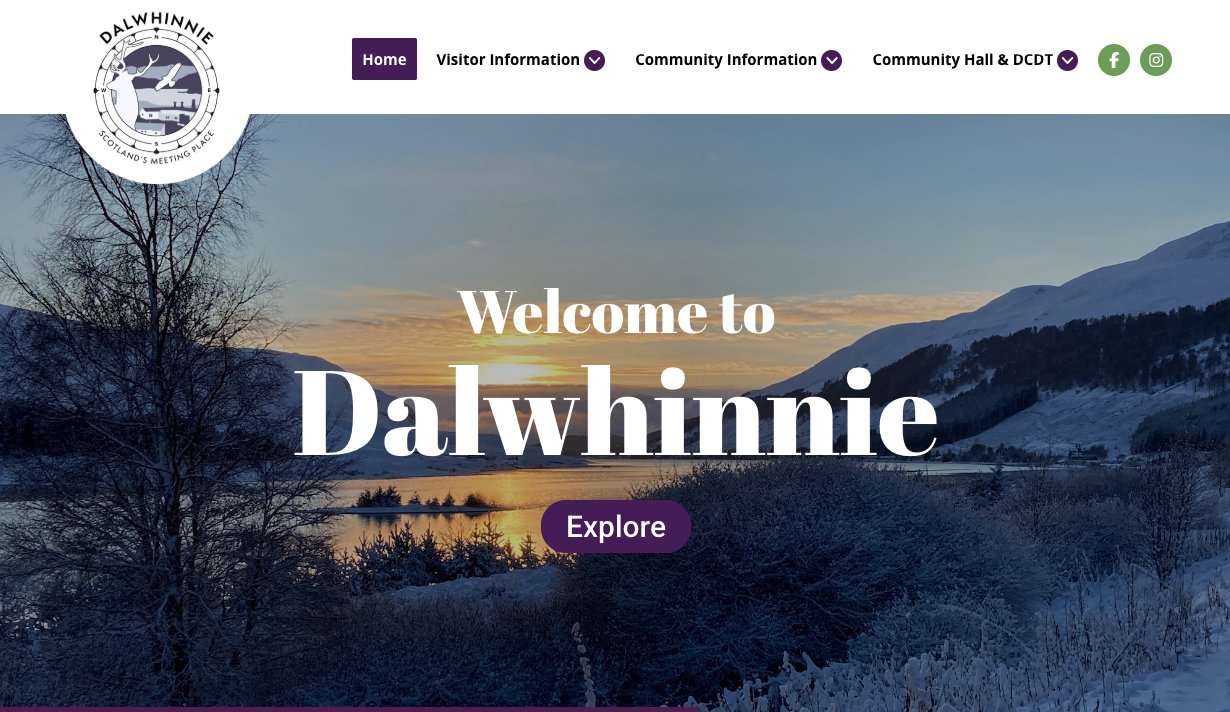
We started with a clear separation of the visitor and community pathways at the top-level navigation — not hidden in sub-menus, not blurred together, but presented as two parallel front doors to the site. From the homepage, a visitor sees route information, accommodation, eating and the distillery within one click; a resident sees community news, DCDT, the hall and contact channels in the same number.
Visually we built around landscape photography and an editorial typographic treatment — large headlines, generous white space, restrained colour palette drawing from Highland greys, deep greens and stone. The aim was something that felt like a well-made magazine more than a community website — a tone that respects both the visitor’s expectation of beautiful Highland imagery and the resident’s expectation of a serious, functional information hub.
The Community Hall and DCDT both got dedicated section areas with their own visual treatment within the unified design system — clearly part of the same site, but distinct enough that you know when you’ve arrived at each. Events and hall booking were integrated directly into the build rather than living on a separate platform, simplifying the experience for both staff and end users.
What we delivered
- Bespoke heritage-led editorial design — large photography, considered typography, restrained colour, with a tone that respects both the Highland setting and the village’s historic identity as ‘Scotland’s Meeting Place’
- Dual-audience information architecture — clear top-level separation of visitor and community pathways, with each audience finding what they need within one or two clicks
- Visitor-facing tourism content — accommodation listings, places to eat, what to see, route planning for cyclists and walkers, distillery information, and seasonal practical advice for travelling at altitude in winter
- Community-facing resident hub — DCDT updates, community news, governance documents, contact channels and resident-only resources
- Dedicated Community Hall section — venue information, capacity, facilities, and direct booking enquiry pathway integrated into the main site rather than on a separate platform
- DCDT pages — trustees, governance, history of the development trust, current projects and community-investment news
- Events listing — central calendar serving both visitor events (markets, festivals) and community events (meetings, hall bookings)
- Highland tourism SEO foundation — structured for ‘places to stay Dalwhinnie’, ‘eat in Dalwhinnie’, ‘Cairngorms accommodation’ and related visitor intent searches
- UK-hosted CMS — the DCDT team and Community Hall managers can update content, add news, post events and manage listings directly
- Mobile-first responsive design — built for phones first since the majority of visitor traffic arrives on mobile, often roadside
See it live
The Dalwhinnie community website is live and in active use by both the village community and visitors travelling through the Highlands — visit it to see the finished build.
Why it works
Most community websites pick one audience and lose the other. They’re either tourism portals where residents can’t find their hall booking form, or community noticeboards where visitors give up looking for accommodation. The Dalwhinnie site refuses to make that compromise: it serves both audiences at full quality, in parallel, and never asks either to dig through content meant for the other.
The editorial heritage-led design is the second piece of the puzzle. It earns visitor trust at first impression — you don’t arrive thinking ‘is this an official site or a hobbyist’s page?’, you arrive thinking ‘this place takes itself seriously’. That single tonal shift dramatically improves conversion on accommodation enquiries, distillery interest and Community Hall bookings, because credibility is doing half the work before any content is read.
For a village of 80 residents punching above its weight as a Highland visitor hub, this is the kind of digital presence that matches the cultural weight of the place itself.
Could we build your website next?
Jabu Designs is a website design, software development, and design and print agency based in Bury St Edmunds. We deliver bespoke websites for businesses, charities and community organisations across Suffolk and the wider UK — whatever your industry, whatever your goals. Alongside website design, we also offer bespoke software development, custom web applications, eCommerce, brand identity and design-and-print collateral — making us a genuine one-stop digital partner for ambitious organisations.