About the project
US Cambridge is a Cambridge-based furniture specialist making beautiful handmade sofas and chairs from scratch, and expertly reupholstering the pieces their clients already own and love. It’s a craft-first business in a mass-market category — handmade sofas from £2,395, made properly, made in the UK, and made to last decades rather than years. The kind of purchase people research carefully, visit in person to sit on, and want to see with their own eyes before committing.
The brief was to build a website that matched the quality of the work itself. The existing web presence didn’t reflect the calibre of what US Cambridge actually make. Buyers researching handmade furniture read visual cues carefully — a site that looks templated signals a business that’s templated, and buyers who’ve made the deliberate decision to look past IKEA and DFS don’t want templated. They want craft.
We were brought in to deliver the full package: brand identity refinement for the digital space, a bespoke website design that carries the same considered aesthetic as the physical product, and separate presentation of the two sides of the business (new-build sofas and chairs vs. reupholstery of existing pieces) without either feeling like a footnote.
The challenge
Three specific problems to solve.
First, the craft-vs-commodity problem. Buyers who search for handmade sofas are typically comparing four or five suppliers in parallel — some genuinely handmade UK makers, some retailers claiming “handcrafted” while shipping factory-made goods from overseas. Buyers filter fast, largely on visual signals. A US Cambridge site that looked commodity would put the business on the wrong side of that filter regardless of the actual quality of the work.
Second, the two-sides-of-the-business problem. New handmade sofas and chairs are the flagship offering, but reupholstery is a genuinely important part of what US Cambridge do — and the two audiences are meaningfully different. New-sofa buyers are typically making a £3K–£10K decision on a piece they’ll live with for a decade or more. Reupholstery clients often have a family piece with sentimental value they want restored properly. Same brand, same craftsmen, but different emotional territory — and the site needed to serve both journeys without collapsing them into one.
Third, the see-it-in-person problem. Sofas are the hardest possible category to sell purely online. Nobody spends four figures on a sofa without sitting on it or visiting the workshop first. The site’s job isn’t to close the sale — it’s to build enough visual and craft credibility that a Cambridge-area buyer picks up the phone and books a workshop visit. That’s the actual conversion point.
Our approach
We treated this as an editorial project first, a web project second. The visual direction landed on a considered, moody aesthetic: dark, atmospheric photography of the actual furniture, generous use of white space, classical serif display typography paired with clean sans-serif for body copy, and a restrained palette anchored by black-and-white with occasional warmer accents drawn from the fabrics themselves.
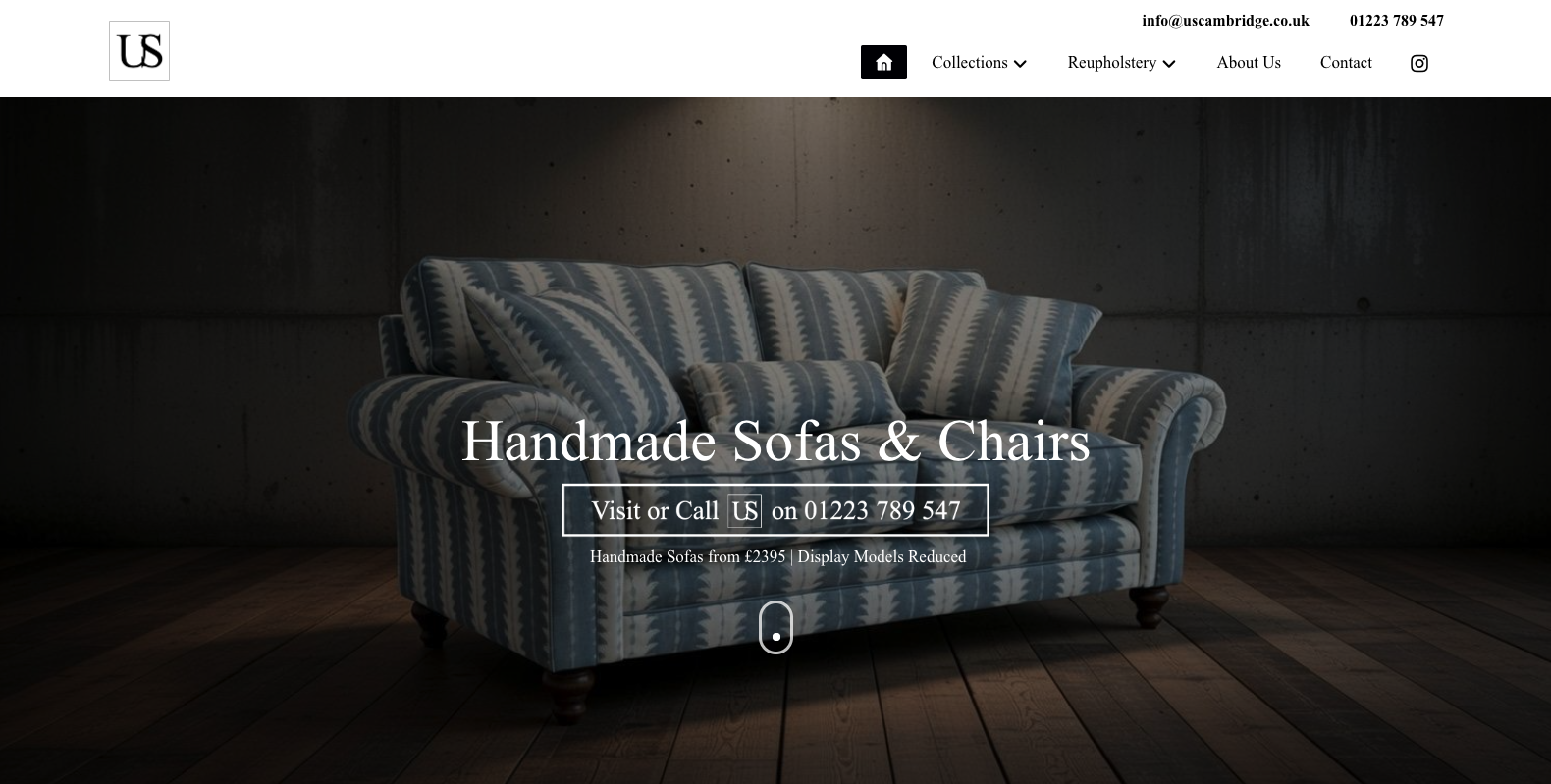
Photography is doing enormous work here. The hero image is a full-bleed shot of an actual US Cambridge sofa — upholstered in a striking blue-and-cream stripe — sitting in an atmospheric, minimally-lit set. It reads immediately as considered, premium, and made-by-hand. Not a stock image, not a catalogue shot, not a lifestyle set. The furniture itself, doing the work.
Information architecture separates the two audiences cleanly. Collections (new-build sofas and chairs) has its own top-level nav section with detailed presentation of the current ranges. Reupholstery has its own dedicated space with its own tone — less “shop the range,” more “let’s talk about your piece.” Contact and workshop-visit paths sit prominently in the header, because those are the actual conversion points.
The pricing signal is handled thoughtfully. “Handmade sofas from £2,395” sits directly under the hero — anchoring value expectations upfront and filtering out casual browsers before they waste both parties’ time. A secondary line, “Display models reduced,” softens that with an incentive for buyers ready to move quickly. Both signals do meaningful work.
For the wider site build, we hand-coded rather than page-built. The US Cambridge site doesn’t need frequent content changes at the page-structure level — the collections update seasonally, the reupholstery service is stable. Hand-coding meant we could tune performance for the heavy imagery the design demanded (large hero shots, considered photography throughout each collection) without compromising load speed on mobile.
What we delivered
- Refined brand identity for the digital space — consistent typographic system, image treatment guidelines, and a restrained palette that reads distinctly premium without straying into cliche
- Full custom website design — hand-coded from scratch, not built on a page builder, not a themed template
- Atmospheric editorial hero photography — full-bleed shots of actual pieces doing the credibility work in seconds
- Collections section — considered presentation of the current handmade sofa and chair ranges, with room to grow as the collection expands
- Dedicated Reupholstery section — separate top-level treatment with its own tone, guiding clients through the process, materials choices, and timeline for restoring pieces they already own
- Workshop visit CTA throughout the site — the actual conversion point for handmade furniture, treated as first-class rather than an afterthought
- Anchored pricing signals — “Handmade sofas from £2,395” upfront to set expectations, “Display models reduced” as a secondary incentive
- Full contact and enquiry workflow — phone number and email visible in the header, enquiry form routed for prompt response
- Instagram integration — social presence woven in, since visual social channels are how much of the handmade furniture audience discovers makers
- Mobile-first responsive build — engineered for phones and tablets first, scaled up for desktop
- Fast Core Web Vitals — heavy imagery handled properly with modern formats, lazy loading, and performance budgeting; the site is fast despite being image-heavy
- UK-hosted infrastructure — SSL, backups, GDPR-compliant enquiry handling
- SEO foundations — structured for “handmade sofas Cambridge”, “bespoke sofa maker UK”, “reupholstery Cambridge” and related buyer-intent searches
See it live
The US Cambridge site is live now — visit to see the full editorial build, browse the current collections, or arrange a workshop visit to see the pieces in person.
Why it works
Most handmade furniture sites fall into one of two traps. Either they look like commodity retailers — catalogue grids, generic photography, upfront “add to basket” buttons — which puts them on the wrong side of the buyer’s craft-vs-commodity filter. Or they look like design agencies’ personal portfolios — beautiful but purposeless, with no clear route to actually enquire, visit, or buy. Neither works for the buyer who’s decided they want handmade British furniture and needs enough confidence to commit £3K to sit on it.
The US Cambridge site avoids both traps by treating the furniture as the proof and the workshop visit as the destination. Photography of actual pieces does the credibility work — there’s no need for lengthy craft-story copy when the pictures show craft directly. Pricing anchors are honest and upfront, filtering the audience effectively. Workshop visits are treated as the primary conversion, not the sofa purchase itself — which matches how these decisions actually get made in the real world.
The two-audiences treatment is the quiet win. Reupholstery and new-build sofas share a brand and a craftsman team but require completely different emotional pitches. The site respects both journeys, letting each audience find their route without either feeling like an afterthought — and that’s the difference between a site that sells one thing well and one that sells two things well.
Could we build your next site?
Jabu Designs is a website design, software development, and design and print agency based in Bury St Edmunds. We work with craft-first businesses, independent specialists and considered brands across East Anglia and the wider UK on projects like this one. Alongside website design and custom development, we offer brand identity, eCommerce, and SEO — a genuine one-stop digital partner for makers, specialists and brands who care as much about how they’re presented as what they present.